Parasite
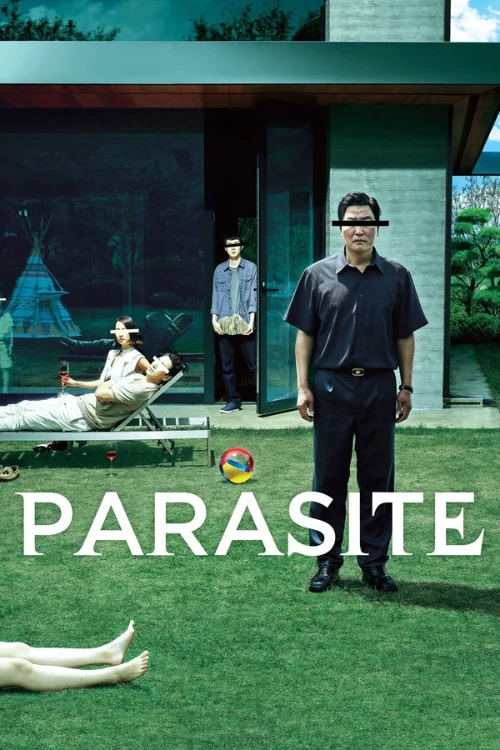
The Kims - mother and father Chung-sook and Ki-taek, and their young adult offspring, son Ki-woo and daughter Ki-jung - are a poor family living in a shabby and cramped half basement apartment in a busy lower working class commercial district of Seoul. Ki-woo is the one who has dreams of getting out of poverty by one day going to university. Despite not having that university education, Ki-woo is chosen by his university student friend Min, who is leaving to go to school, to take over his tutoring job to Park Da-hye, who Min plans to date once he returns to Seoul and she herself is in university. The Parks are a wealthy family who for four years have lived in their modernistic house designed by and the former residence of famed architect Namgoong. While Mr. and Mrs. Park are all about status, Mrs. Park has a flighty, simpleminded mentality and temperament, which Min tells Ki-woo to feel comfortable in lying to her about his education to get the job. In getting the job, Ki-woo further learns that Mrs. Park is looking for an art therapist for the Parks' adolescent son, Da-song, Ki-woo quickly recommending his professional art therapist friend "Jessica", really Ki-jung who he knows can pull off the scam in being the easiest liar of the four Kims. In Ki-woo also falling for Da-hye, he begins to envision himself in that house, and thus the Kims as a collective start a plan for all the Kims, like Ki-jung using assumed names, to replace existing servants in the Parks' employ in orchestrating reasons for them to be fired. The most difficult to get rid of may be Moon-gwang, the Parks' housekeeper who literally came with the house - she Namgoong's housekeeper when he lived there - and thus knows all the little nooks and crannies of it better than the Parks themselves. The question then becomes how far the Kims can take this scam in their quest to become their version of the Parks.
Audience Reviews
Rate and Review

Bong Joon Ho’s 2019 masterpiece, Parasite, examines the class divide of modern capitalism and the intricate layers of human nature through an unprecedented cinematic lens. Following the impoverished Kim family as they gradually infiltrate the lives of the wealthy Park family, the film seamlessly weaves black comedy, psychological thriller, and sharp social tragedy. The director’s true brilliance lies in refusing to reduce the narrative to simple morality; instead, he presents every character as both victim and perpetrator within an unforgiving economic system. The film’s spatial storytelling and production design are extraordinary. The vertical hierarchy—contrasting the Kim family’s subterranean semi-basement apartment with the Parks’ sun-drenched, architecturally pristine hilltop mansion—physically embodies social stratification. Staircases serve as a central motif, illustrating that upward mobility is merely a fleeting illusion, whereas downward descent remains an absolute certainty. A pivotal torrential rain sequence underscores this brutal contrast: for the wealthy, the storm is merely an aesthetic spectacle, while for the destitute, it is a catastrophic disaster that washes away their livelihood. Furthermore, the recurring theme of "smell" operates as an indelible, invisible marker of class distinction that no level of deception can erase. Bong Joon Ho navigates genre transitions with masterly precision. What begins as a clever, lighthearted heist-like scheme transforms abruptly into an intense psychological thriller upon the discovery of the hidden subterranean bunker. The ensemble cast delivers flawless performances, anchored by Song Kang-ho’s haunting portrayal of quiet desperation and ultimate disillusionment. Parasite stands as a timeless, universally resonant critique of modern socioeconomic structures and a undeniable triumph of global cinema.